
Government and Politics
Department Staff
Head of department: Ms M Collins
What is Politics?
Politics is the study of government and institutions and decision-making processes that govern the world we live in. This is a subject that asks you consider how we are governed, how we elect representatives, how governments are formed and how they work. Recent events pose the question of how people like Donald Trump and Boris Johnson gained the top positions in government, how Brexit came about, why Scottish Independence remains a divisive issue in the UK and whether a United Ireland will ever happen. Politics also helps us understand different ideologies and ideas such as right and left wing, justice, democracy, equality, and freedom, and how power is distributed around the world.
Our department aim
The Aim of the department is to develop a lifelong interest in government and politics. To help students form their own beliefs about political issues and events and engage with a subject that affects us all on a day-to-day basis. Students consider important political concepts such as power, authority and accountability while ascertaining who has the power and how it is exercised. Students are encouraged to think critically about the political systems in which they live and how they might participate in those systems as well as develop as effective and independent learners, who are able to analyse and critically evaluate a range of differing viewpoints.
What skills will students develop?
Politics is an academically challenging and demanding subject. Students must have an inquisitive mind and have an interest in current affairs. They must be prepared to read widely outside of the classroom as well as watching the news, political programmes, and documentaries. Students must be prepared to go above and beyond in this subject and in doing so will find this a very enjoyable and rewarding experience. The study of Politics will develop key skills including critical thinking, analysis, research, independent learning, public speaking, and problem solving.
Key stage 4 provision
CCEA GCSE Government and Politics
Unit 1 Democracy in Action (50%)
- Political ideas and concepts
- Decision-making in a democracy
- Elections and voting in a democracy
- Political parties in a democracy
- Political information in a democracy
- Taking action in a democracy
Unit 2 International Politics in Action (50%)
- Interdependence
- The European Union
- Conflict and its resolution
- Conflict resolution in practice – Northern Ireland
- Migration
The GCSE Politics course is modular. Pupils sit the Unit 1 examination at the end of Year 11, and the Unit 2 examination at the end of Year 12. Both examinations are worth 50% of the overall GCSE.
Key stage 5 provision
CCEA GCE A level Government and Politics
YEAR 13 AS LEVEL (40% OF FULL EXAM)
The students complete two modules in Politics at AS level:
- AS1 The Government & Politics of Northern Ireland
- AS2 The British Political System
YEAR 14 A2 LEVEL (60% OF FULL EXAM)
The students complete two further modules at A2:
- A21 Comparative Study of the Government and Politics of the United States of America and the United Kingdom
- A22 Political Power
The GCE Politics course is modular. Pupils sit the AS1 and AS2 examinations at the end of Year 13, and the A21 and A22 examinations at the end of Year 14. The AS examinations are worth 40% of the overall A Level. The A2 examinations are worth 60% of the overall A Level.
Educational visits
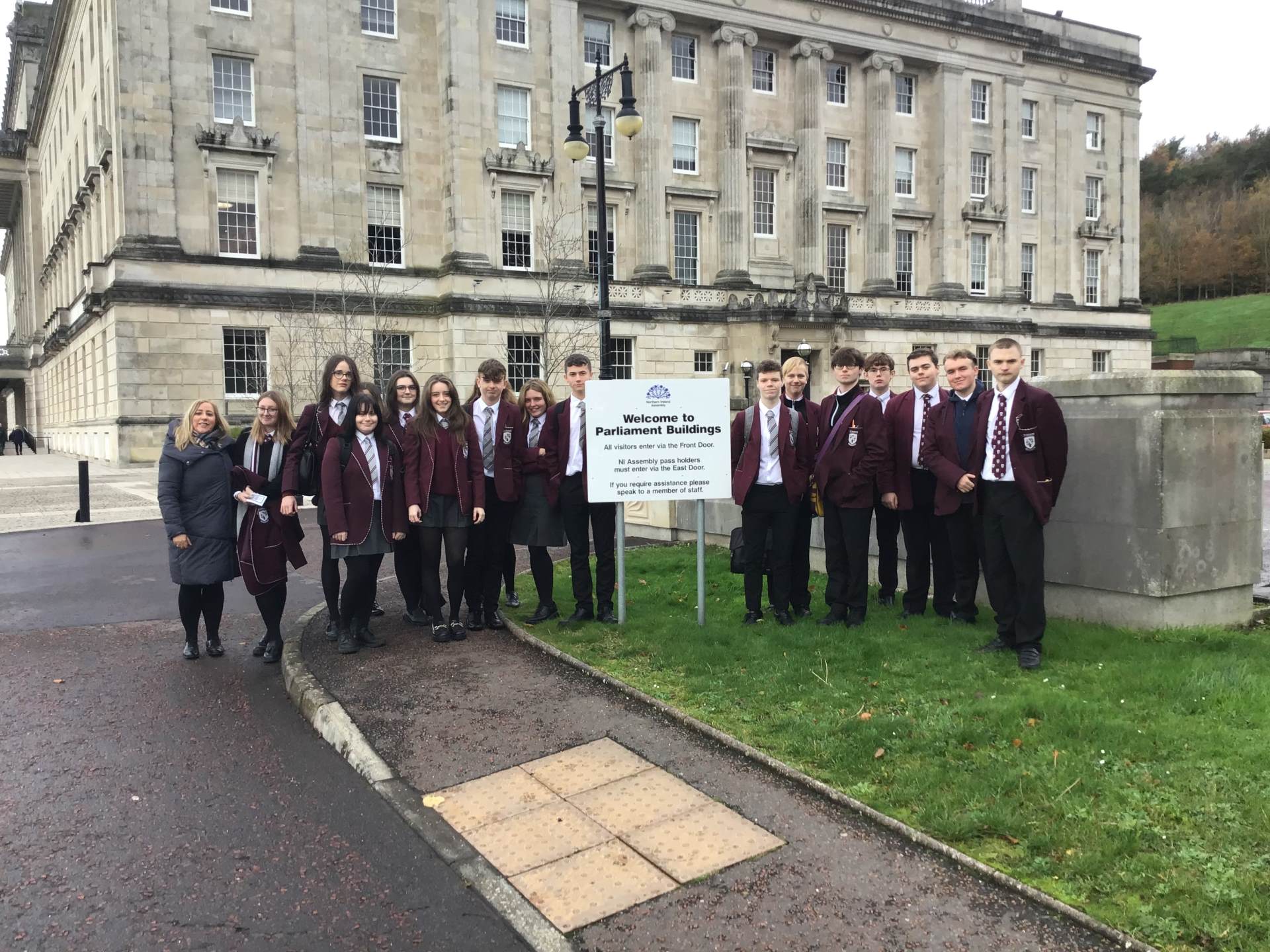
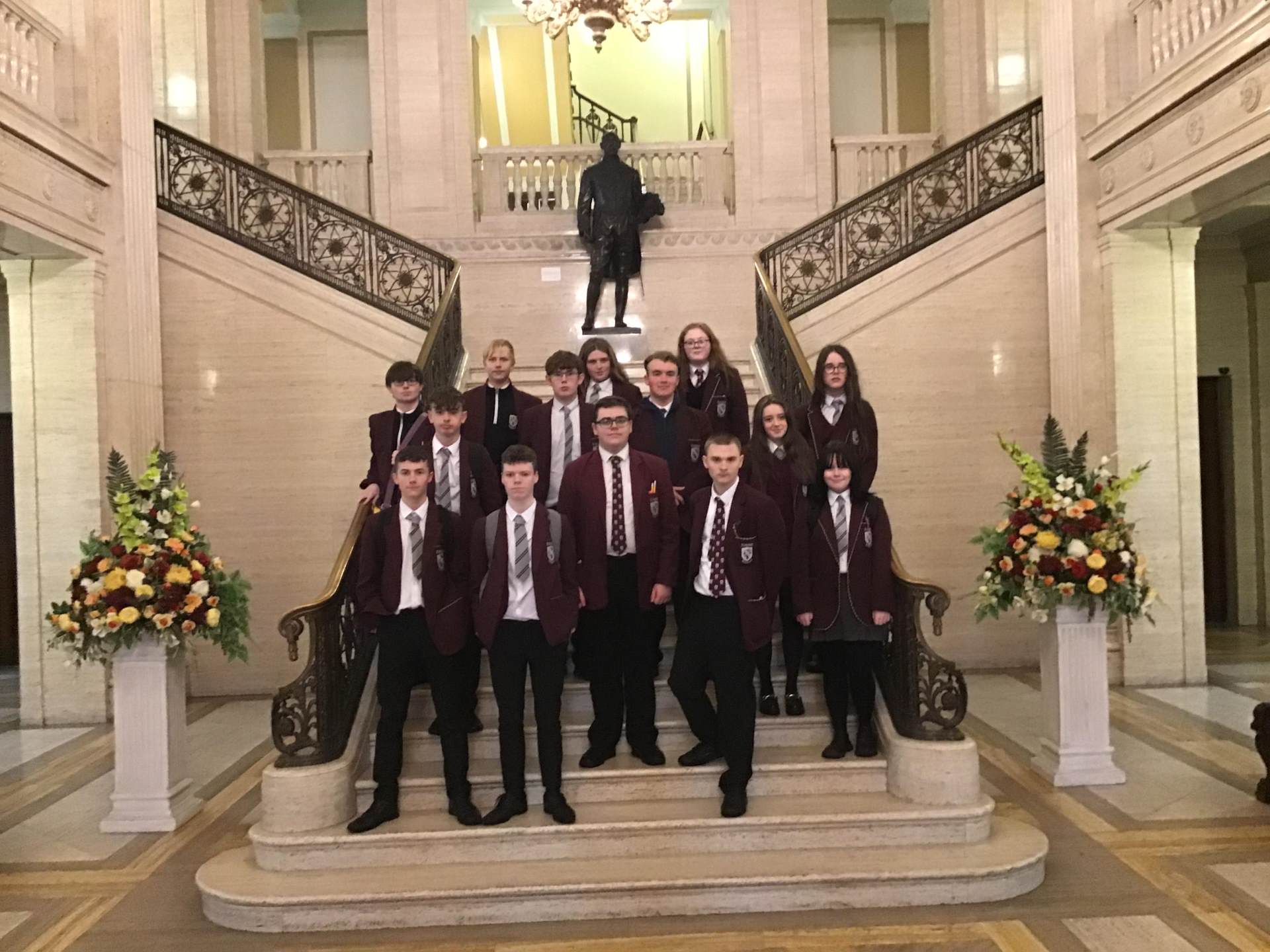
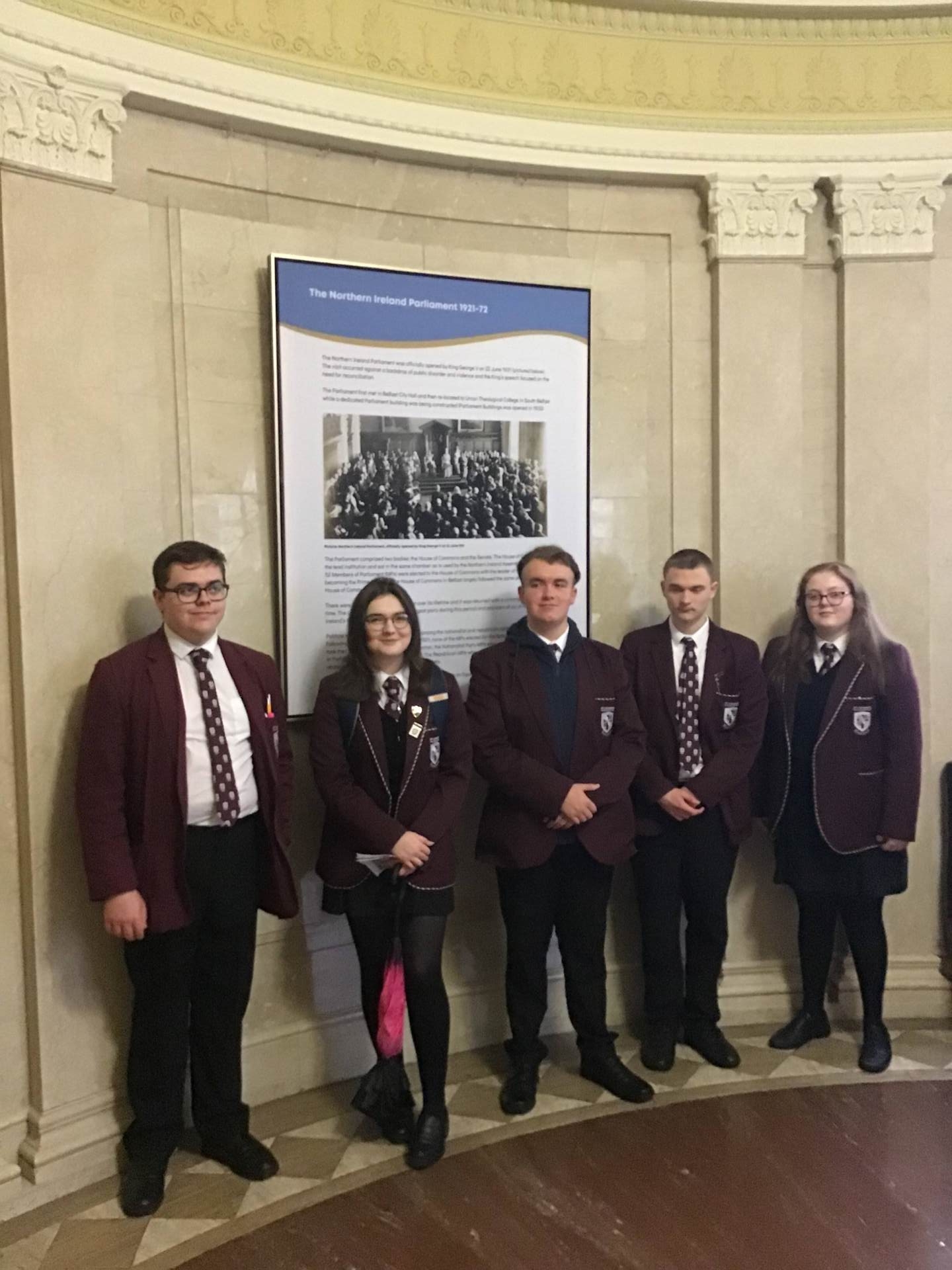
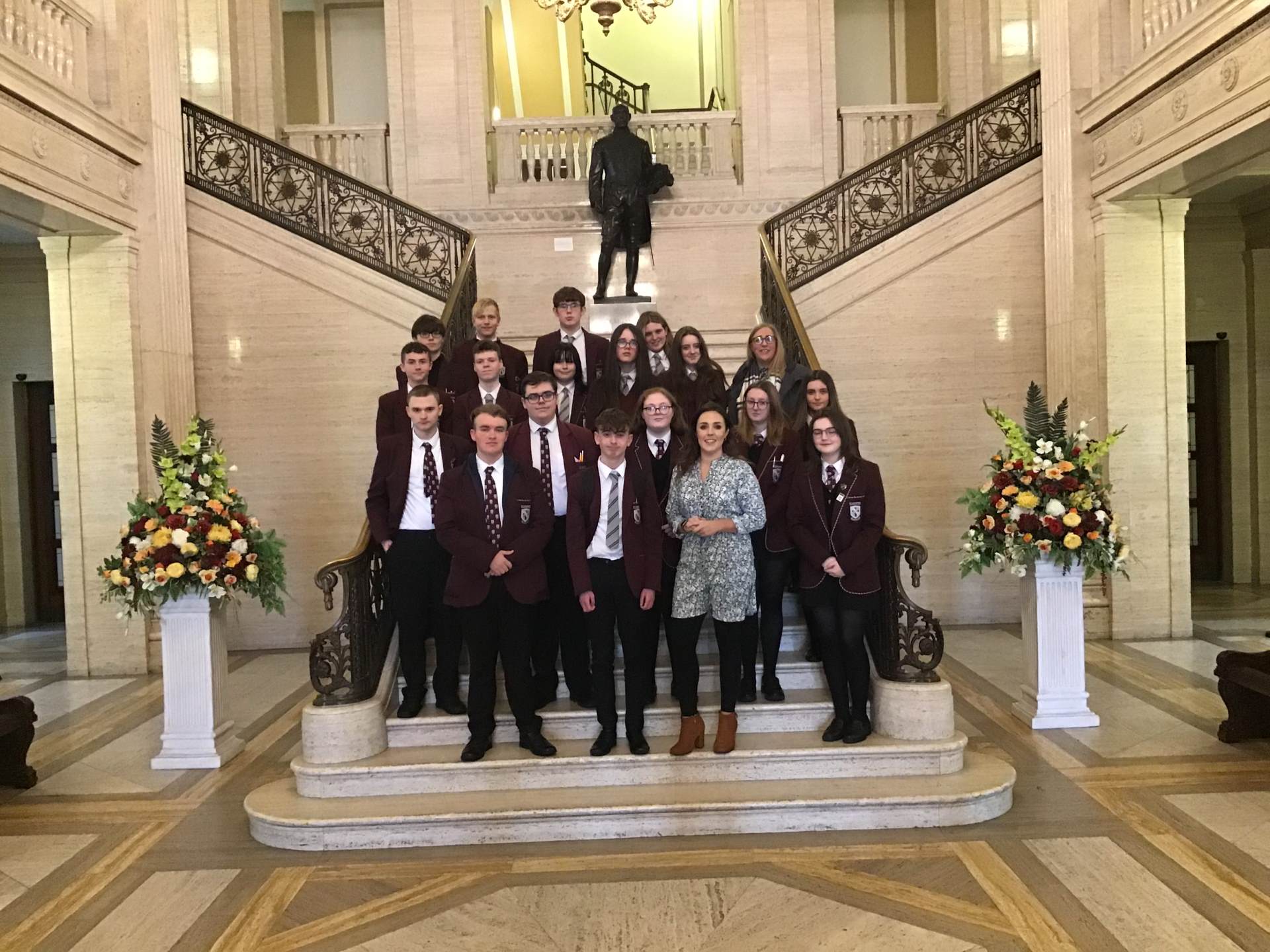
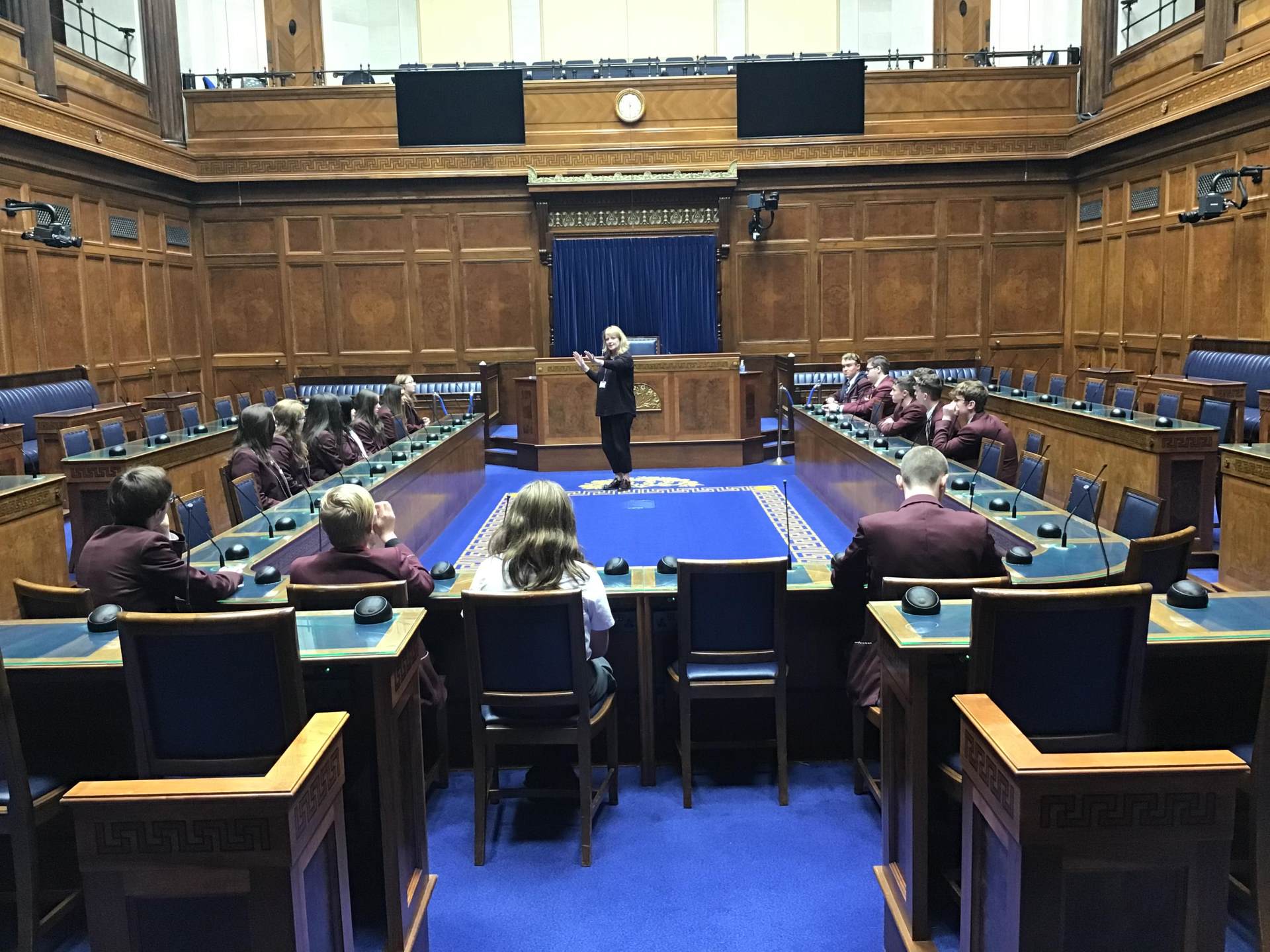
The Politics Department endeavours to generate students’ interest in the subject beyond the classroom. GCSE and A level students visit Government Buildings at Stormont annually and get to see the assembly at work. Students meet MLAs from a range of political parties including Nick Mathison (Alliance), Chris Hazzard (SF), Mike Nesbitt (UUP), Cathy Mason (SF) and Colin McGrath (SDLP) amongst others.
One of our A level students, Connor McVarnock won a competition through the Comber Rotary Club and attended the European Parliament along with other pupils from various school across Northern Ireland and was a guest on BBC’s Question Time. Other pupils, Shea O’Hare and Michael McCauley have also attended a trip to Derry for the European Parliament Ambassadors School Programme (EPAS) in the Guildhall where students from Ireland and NI discussed issues with MEPs, MPs, and community leaders on European citizenship, democracy, peacebuilding, and reconciliation.
Stormont visit
Career pathways
There are many opportunities for Politics students in various career paths including:
- Politics
- Law
- Journalism
- Civil service
- Teaching
- Public Relations
- Lobbying
This is a subject that contains many transferable skills such as communication, decision making and listening skills and will enable you to gain a career in other professions such as Publishing, Advertising, Media, Business Technology, Social Work, Marketing, Human Resources, and Information Technology.